The Caffeine Colonialist: Why Your "Local" Pour-Over is Starving the Soil
The flavor profile of the modern digital nomad hub is exact. Whether you are in Canggu, Medellin, or Lisbon, the tasting notes are the same: unfinished concrete, monstera plants, download speeds of 100mbps, and a cup of coffee that tastes like lemon tea.
I am currently sitting in a café in Bali that ticks every one of these boxes. The barista, a local master of his craft, is weighing my grounds on a Bluetooth-connected scale. The menu claims the beans are "Single Origin" and "Locally Sourced."
To Nomad Noah, this is the dream: high-speed Wi-Fi and the feeling of supporting local agriculture. To Executive Elena, this is a safe harbor: organic, clean, toxin-free caffeine.
But my palate forensics tell a different story.
I took a sip. It was bright, acidic, and aggressively "clean." It tasted expensive. It also tasted like a lie.
Traditional Indonesian coffee–Kopi Tubruk–is heavy, dark, and earth-bound. It mirrors the volcanic soil it grows in. The liquid in my cup had been washed, fermented, and roasted to strip away that terroir and replace it with a flavor profile dictated by buyers in Melbourne and Brooklyn.
We aren't drinking the landscape. We are drinking gentrification.
Here is the supply chain reality behind your $6 pour-over.
 The Caffeine Colonialist
The Anatomy of a "Green Desert"
I hopped on a scooter and rode two hours north, away from the co-working spaces and into the hills. I wanted to see the "Organic" farm listed on the bag.
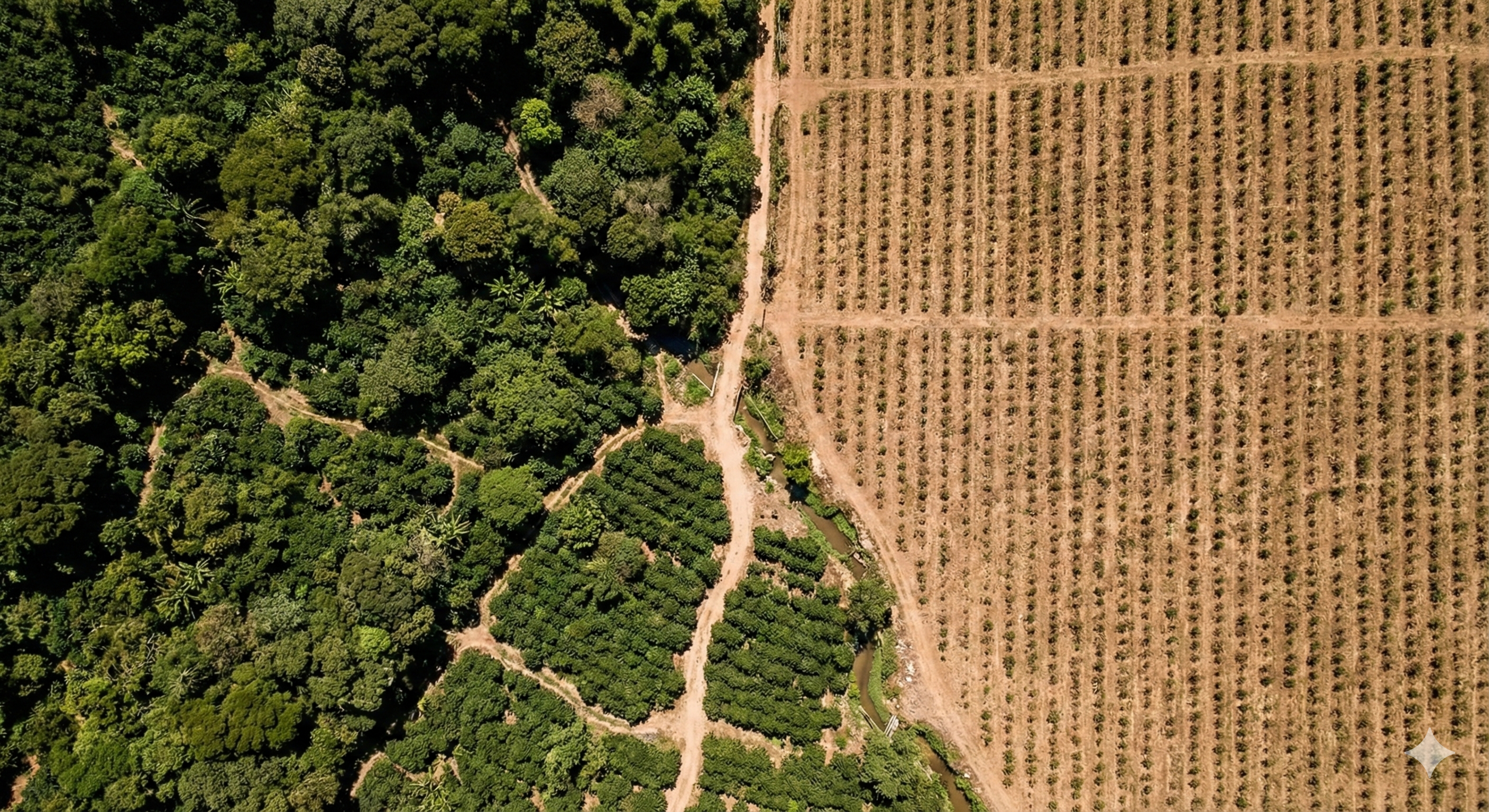
When Executive Elena buys organic, she imagines a lush, chaotic garden. She imagines biodiversity. What I found was a monoculture grid.
Coffee is biologically designed to be an understory plant. It evolved to grow slowly in the cool shade of a forest canopy. But shade-grown coffee yields fewer beans and takes longer to ripen.
To feed the global demand for "Specialty Coffee," farmers are pressured to cut down the canopy. They expose the shrubs to full, scorching tropical sun.
The result is "Sun-Grown Coffee." It grows fast. It yields high profit margins for one or two seasons. But without the trees to drop leaves and compost the earth, the soil boils. It loses its nitrogen. To keep the zombie-plants alive, the farmer must pump the land with fertilizers.
You might be drinking a "chemical-free" bean, but you are funding a system that strips the land of its immune system. You are sipping on soil exhaustion.
Flavor Imperialism: The War on Robusta
There is a dirty word in the high-end coffee world: Robusta. We are taught by coffee snobs that Arabica is the gold standard–delicate, complex, superior. Robusta is dismissed as bitter trash, fit only for instant coffee.
This isn't just a preference; it's a colonial hangover.
In places like Vietnam and parts of Indonesia, Robusta is the heritage crop. It is resilient. It resists pests without pesticides. It handles heatwaves that kill Arabica plants.
But because it tastes "earthy" and "bitter"–flavors the Western palate has deemed "low class"–we force farmers to rip out resilient heritage crops and plant fragile Arabica varietals that require constant babying and heavy water inputs.
When I order a coffee in these regions, I don't want the delicate tea-like wash. I want the punch. I want the grit. By rejecting the local palate, we aren't just being snobs; we are threatening the genetic diversity of the world's coffee supply.
The "Direct Trade" Illusion
Non-Profit Nina looks for the "Direct Trade" sticker. She believes it means the money goes to the farmer.
Here is the "supply chain radical" truth: Direct Trade is a marketing term, not a legal one. It often means a roaster from London bought directly from a plantation owner in Brazil. The owner gets the premium; the pickers often still get pennies.
If you want to disrupt the extraction model, stop looking for "Direct Trade." Look for one word: Cooperative.
In a Cooperative (Cooperativa), the farmers own the processing machinery. They own the de-pulping station. They own the drying beds.
When you sell raw coffee cherries (the fruit), you get the lowest price. When you sell the "green bean" (processed and dried), you get a higher price. When the farmers own the machines, they capture that value. The profit stays in the village to build schools and roads, rather than vanishing into a bank account in the capital city.
The Radical’s Pantry: How to De-Colonize Your Cup
I am not telling you to stop drinking coffee. I am a cook, not a monk. But if you want your morning ritual to feed the soil rather than starve it, you need to change your metrics.
1. Drink the "Bird Friendly" Label Forget "Organic." Look for the "Bird Friendly" certification from the Smithsonian. It is the strictest shade-grown certification in existence. It guarantees that the coffee was grown under a canopy of native trees that support migratory birds and soil health. If the farm doesn't have birds, it doesn't have a future.
2. The Robusta Challenge Next time you are in a coffee-growing region, ask the barista: "Do you have a roast that the locals drink?" It might be dark. It might have sugar added to the roasting process (a common technique in Southeast Asia). It might taste like smoke and mud. Drink it. That is the taste of resilience.
3. The Café Audit If you are working from a café, look at the food. If the menu is entirely Avocado Toast and Acai Bowls (crops that often require heavy water imports in these regions), you are in a tourist bubble. Find the spot serving the local breakfast porridge or rice dish. The coffee there will be half the price, and I guarantee the owner is the one behind the counter, not a foreign investor group.
The Bottom Line: True sustainability isn't found in a compostable cup. It’s found in the soil. If your coffee tastes too clean to be true, it probably is. Drink the dirt.