The "Compostable" Lie: Why Your Corn-Starch Cup is Pollution
The smoothie cup in your hand in Tulum looks innocent. It is translucent, stamped with a green leaf, and proudly announces it is "100% Plant-Based" and "Compostable."
You finish your drink. You toss the cup in the recycling bin, believing you have just participated in a circular economy. You believe that because it is made of corn, it will return to the earth like an apple core.
You are wrong.
In a backpacker hub lacking industrial infrastructure, that cup is not a solution. It is a time bomb.
As a sustainability auditor, I track supply chains to their termination points. I do not stop at the bin. I follow the garbage truck. In places like Tulum, Bali, and Thailand, the "Eco-Friendly" disposable industry has outpaced the waste management reality. The result is a flood of Polylactic Acid (PLA) plastic that is marketed as nature-friendly but behaves exactly like petroleum when it enters the wild.
Here is the lifecycle audit of the "corn cup" and why it belongs in the trash, not the garden.
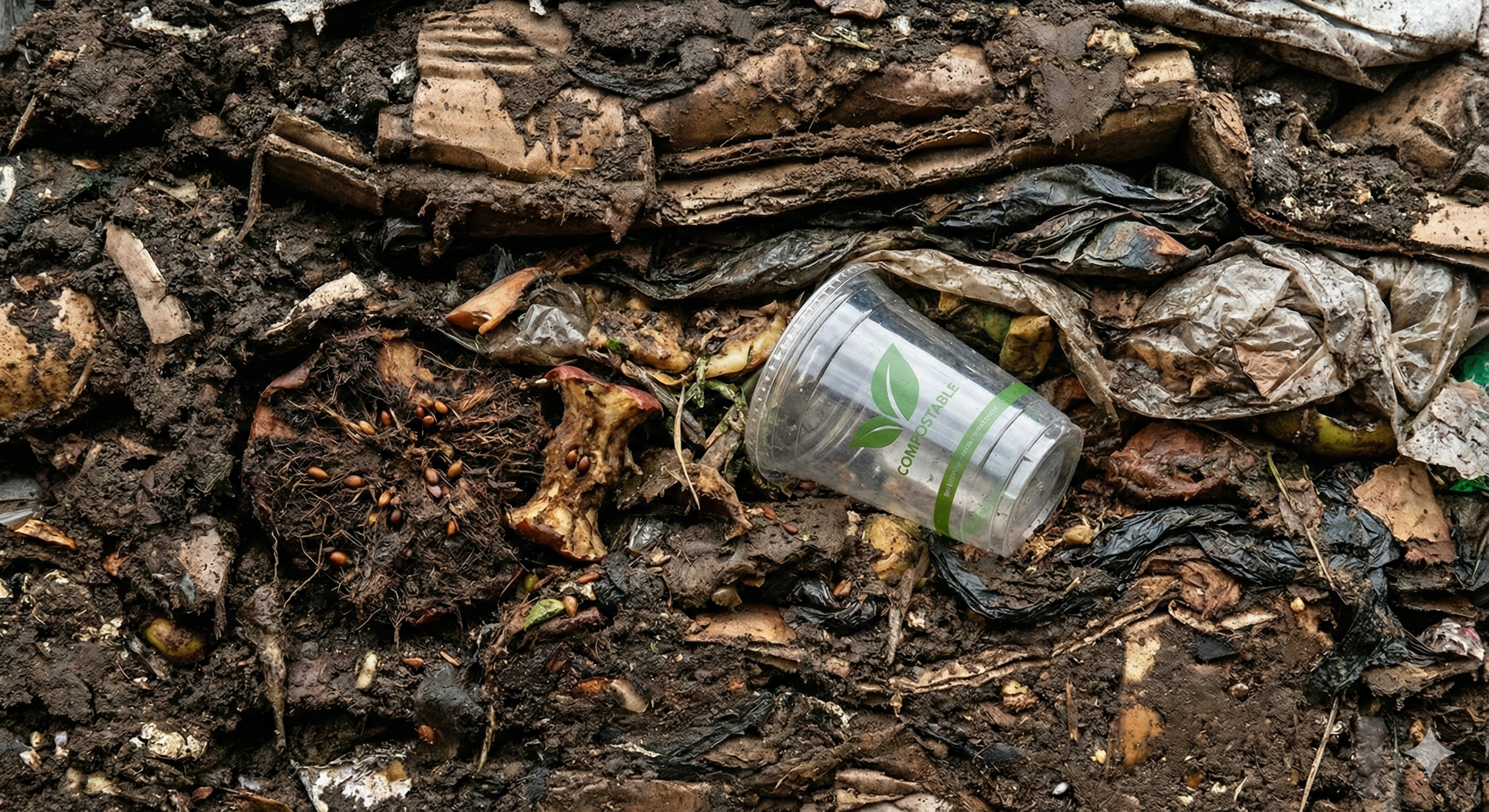 The Compostable Lie
The Chemistry of Illusion
The term "Compostable" is a legal definition, not a biological guarantee.
For a PLA cup to decompose, it requires a specific environment: an industrial composting facility that maintains a core temperature of 140°F (60°C) for at least ten consecutive days, combined with specific humidity and microbial levels.
I audited the waste management systems of three popular "eco-tourism" towns in Mexico and Southeast Asia. The number of industrial composting facilities I found was zero.
Without that intense heat, the corn-starch cup does not biodegrade. It remains a polymer. If you bury it in the sand or throw it in a home compost pile, it will remain intact for decades. It is technically plant-based, but functionally, it is litter.
The Methane Factory
When "Gap-Year Gabe" throws this cup into a general waste bin, it ends up in a landfill.
In a landfill, waste is compacted and buried in an anaerobic (oxygen-free) environment. When organic materials like PLA break down without oxygen, they do not turn into soil. They undergo methanogenesis. They release methane, a greenhouse gas that is 28 times more potent than carbon dioxide at trapping heat. By switching from standard plastic (which is inert in a landfill) to "compostable" plastic (which gasses off in a landfill), we are inadvertently accelerating climate change in the name of being green.
The Marine Decoy
We switch to corn cups to save the turtles.
But the ocean is a cold environment. It acts as a refrigerator, preserving the structure of PLA.
When a corn-starch cup enters the water, it does not dissolve. It fragments. It turns into microplastics that are chemically indistinguishable from oil-based plastics to the marine life that eats them. A turtle cannot tell the difference between a petroleum bag and a corn bag. Both cause blockages. Both cause death.
The Marketing sleight of hand
The industry relies on your linguistic confusion between two terms:
- Biodegradable: A vague, unregulated term meaning it will break downeventually (technically, everything is biodegradable given a million years).
- Compostable: A specific term meaning it breaks downquickly undercontrolled conditions.
If a café hands you a PLA cup but does not have a separate, dedicated "Industrial Compost" bin that is collected by a specialized service, they are greenwashing you. They are selling you a feeling of absolution while passing the burden of disposal to a municipality that cannot handle it.
The Verdict
We cannot buy our way out of the waste crisis with new types of single-use items. We are simply swapping a permanent pollutant for a conditional one, and the conditions do not exist.
The most sustainable disposable cup is the one that was never made.
To truly lower your impact, you must reject the "plant-based" narrative. If you are in a location without industrial composting (which is almost everywhere you travel), treat that corn cup exactly like a plastic one. It goes in the trash, where it is sequestered, or better yet, it is refused entirely.
Stop looking for the "Green Leaf" icon. Look for the "Reusables Only" sign. Carry your own steel or silicone cup. The only material that truly leaves no trace is the one you wash and use again. Refuse the corn. Choose the durable.