The Electron Highway: Engineering the 2,000-Mile EV Road Trip
Range anxiety is not a mechanical failure. It is a failure of mathematics.
Most drivers treat an Electric Vehicle battery like a gas tank. They drive until it is empty, then they want to fill it until it is full. In the world of internal combustion, this binary logic works. In the world of electrons, it is the primary cause of a ruined vacation.
I recently engineered a 2,000-mile traverse across the continent to test the viability of the long-haul electric road trip. My vehicle was not a science experiment. It was a high-performance EV designed for "Luxury Liam" levels of comfort. My goal was to prove that with the right software stack and a basic understanding of physics, the electric road trip is actually superior to the fossil-fuel alternative.
The secret is not a bigger battery. It is a better algorithm. Here is how to delete the anxiety and optimize the journey.
 The Electron Highway
The Physics of Drag
The enemy of range is not distance. It is air resistance.
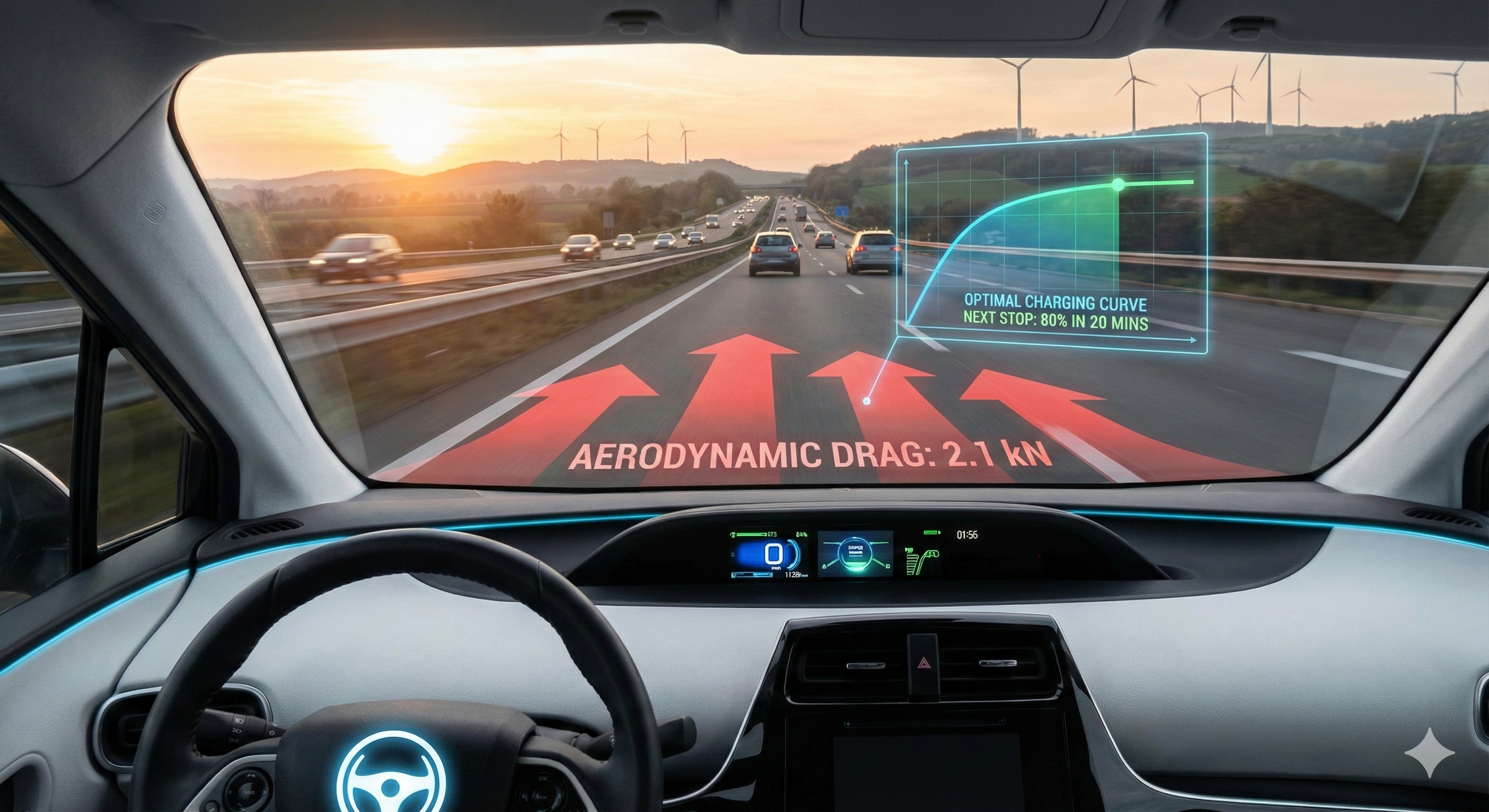
Internal combustion engines mask the penalty of speed because gasoline is energy-dense. In an EV, the penalty is visible in real-time. Drag is not linear. It is exponential. Driving at 80 mph requires significantly more energy than driving at 65 mph.
On my trip, I monitored the consumption graph. At 70 mph, I was achieving 3.2 miles per kWh. At 85 mph, that efficiency dropped to 2.4 miles per kWh. By trying to arrive twenty minutes sooner, I was necessitating an extra forty-minute charging stop.
If you are low on electrons and the next charger is fifty miles away, do not turn off the AC. Just lift your foot. Dropping your speed by 10 mph is the most effective range extender you own.
The Charging Curve
Stop charging to 100%.
Lithium-ion batteries have a specific "charging curve." They accept energy like a sponge accepting water. When the sponge is dry, it soaks up water instantly. When it is nearly wet, you have to force the last few drops in slowly.
An EV might pull 250kW of power when the battery is at 10%, adding hundreds of miles of range in minutes. But once it hits 80%, that speed throttles down dramatically to protect the cell chemistry. Waiting for that last 20% can take as long as the first 80%.
This is where the "Splash and Dash" strategy wins. It is mathematically faster to stop twice for fifteen minutes (riding the peak of the charging curve) than to stop once for an hour (waiting for the trickle charge).
The Software Stack
Do not trust the guess-o-meter on your dashboard. It is often reacting to your past driving history rather than the terrain ahead.
To engineer a perfect trip, you need A Better Routeplanner (ABRP) . This app is the gold standard for EV logistics. It allows you to input your specific car model, the payload weight, and even the weather conditions. It then calculates the route based on topography and charger availability, telling you exactly which station to hit and how long to charge.
I cross-reference this with PlugShare . ABRP tells me where the chargers are. PlugShare tells me if they are broken. It is a crowd-sourced platform where drivers check in. If the last check-in says "Screen broken" or "Low voltage," I abort and reroute.
The Silent Luxury
For the skeptical traveler, the argument for the EV usually centers on carbon. But the real argument is fatigue.
An internal combustion engine creates vibration and noise. Over a ten-hour day, that low-frequency rumble exhausts the nervous system. The EV is silent. The lack of vibration means you arrive at your destination with a significantly higher reserve of biological energy.
This is not just about saving the planet. It is about upgrading the experience. The torque is instant. The center of gravity is low. The cabin is a sanctuary.
The Optimization Protocol
Download ABRP tonight and input your dream road trip. Adjust the settings to prioritize "Shortest Arrival Time" rather than "Fewest Stops." You will see the logic shift immediately. The algorithm will fragment the drive into manageable two-hour stints with rapid fifteen-minute charges. This is not an inconvenience. It is a bio-break and a coffee run. By the time you have your espresso, the car is ready. The infrastructure is there. The only thing missing is the math. Do the numbers, trust the curve, and drive.