The Loudest Place on Earth is Silent: Chasing Acoustic Ecology
The darkness in the Peruvian Amazon does not fall. It rises. It comes up from the soil like a tide, bringing with it a wall of sound so dense it feels physical.
I am sitting in a canoe on a tributary of the Madre de Dios river. I cannot see my own hand in front of my face, but I have never felt more clearly located in space.
To my left, a chorus of tree frogs is vibrating at a frequency that rattles my ribcage. Above me, the cicadas are screaming in a high-voltage buzz. A howler monkey adds a bass note that travels three miles through the canopy.
This is the loudest place I have ever been. And yet, for the first time in months, my mind is completely silent.
We live in a world that is visually overstimulated but acoustically dead. For "Executive Elena," the modern city is a cacophony of disorganized noise. Sirens, notifications, traffic, and construction create a "soundscape of anxiety" that keeps our nervous systems in a state of constant, low-grade fight or flight.
We travel to escape this. We book the villa. We hike the trail. But often, we forget to switch off our primary sense. We look at the view, snap the photo, and miss the symphony.
I came to the rainforest to practice "Acoustic Ecology." I wanted to know what the world sounds like when humans are not the conductor.
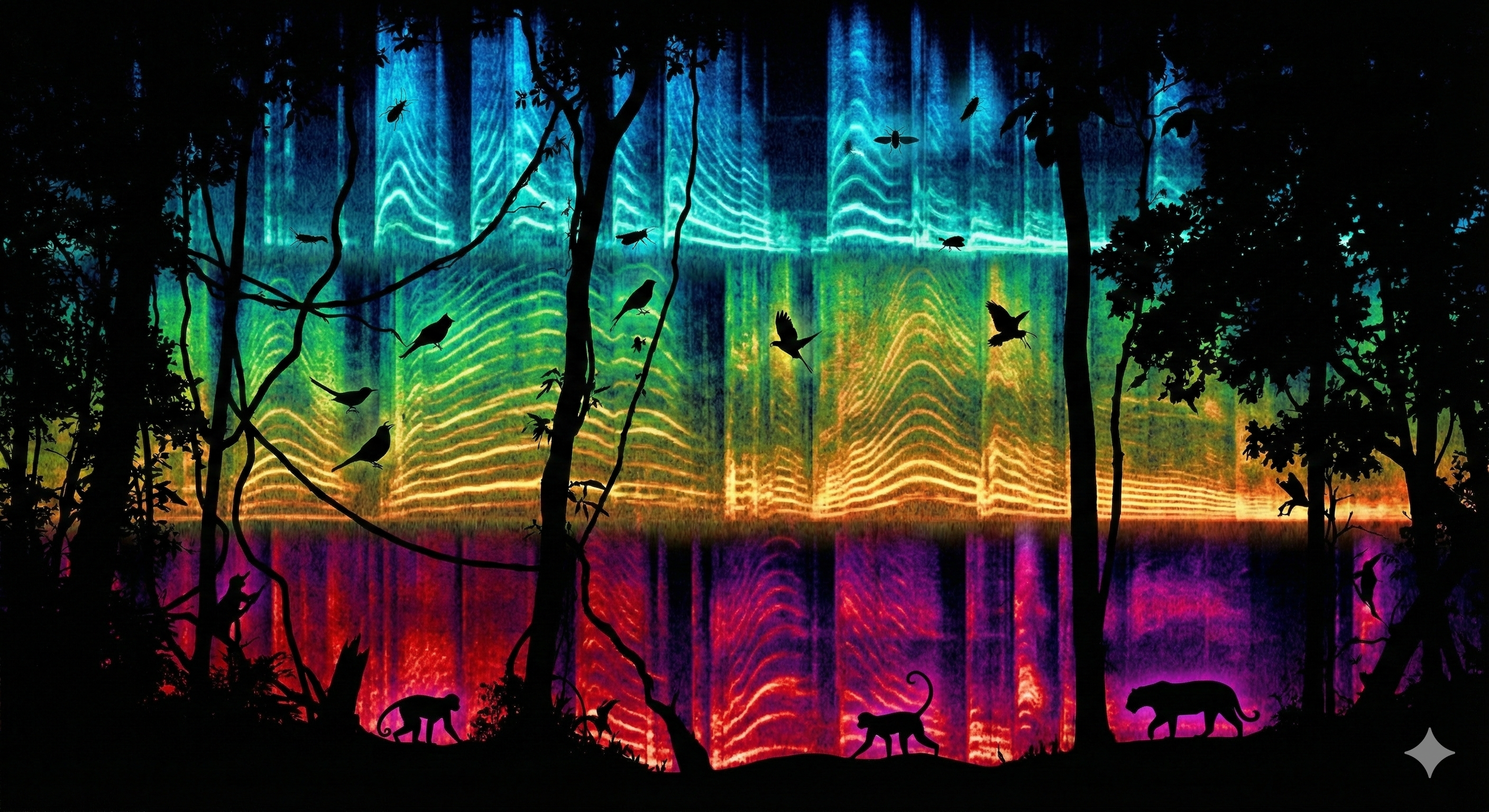 The Loudest Place On Earth Is Silent
The Orchestra of Evolution
Acoustic Ecology is the study of the relationship between living beings and their environment through sound.
In a healthy ecosystem, sound is not chaos. It is a perfectly organized orchestra. This is known as the "Biophony."
Bernie Krause, a pioneer in this field, discovered that animals evolve to vocalize in specific frequency niches to avoid jamming each other's signals. The insects take the high frequencies. The birds take the mid-range. The mammals take the lows.
When you sit in a primary rainforest, you are hearing millions of years of evolutionary negotiation. Every creature has its slot on the radio dial.
This is why the noise of the Amazon feels restorative rather than exhausting. It has rhythm. It has structure. It is a "living silence" that invites you to join it, rather than a wall of industrial noise that pushes you away.
The Fragility of the Signal
But this orchestra is fragile.
During my third night, a motorized canoe passed by, perhaps two miles away. The engine was a dull, mechanical drone.
Instantly, the jungle changed. The "Acoustic Horizon" shrank. The frogs stopped. The birds paused.
This is the invisible damage of tourism. We worry about our carbon footprint, but we rarely consider our "acoustic footprint."
When we bring our engines, our drones, and our loud voices into these spaces, we act as static interference. We jam the signals that animals need to find mates and hunt food.
I realized then that silence is not a luxury. It is an endangered resource.
Gordon Hempton, an acoustic ecologist, searches for "One Square Inch of Silence," a place where you can listen for fifteen minutes without hearing a single man-made sound. There are fewer than a dozen such places left in the United States.
The Art of Resonance
For "Curious Chloe," who wants to feel a deep connection to a place, the ears are a more powerful tool than the eyes.
Vision is object-oriented. It separates us from the world (subject looking at object). Hearing is immersive. Sound touches us. It enters the body.
To truly "be" in a place, you must learn to tune into it.
I spent my final morning practicing a "Soundwalk." I moved at the pace of a snail. I stopped trying to identify the sounds (naming is a function of the intellect) and just let them wash over me (a function of the senses).
I heard the wet tear of a leaf falling. I heard the dry scratch of a beetle. I heard the difference between the wind in a palm tree versus the wind in a kapok tree.
By the time I returned to the lodge, I felt a heavy, sweet exhaustion. It was the feeling of being fully recalibrated. I had not just seen the Amazon. I had resonated with it.
Field Notes: How to Audit Your Soundscape
You do not need to go to the Amazon to practice acoustic ecology. You can find the "One Square Inch of Silence" in your local park or your own backyard.
1. The 15-Minute Reset Nature has a reset button. When you enter a forest, the birds and animals go quiet because you are a predator. It takes approximately 15 to 20 minutes of stillness for the "baseline" activity to resume. Most hikers never hear the true woods because they never stop moving. Find a spot. Sit down. Wait for the curtain to rise.
2. The Audio Audit Close your eyes. Identify the furthest sound you can hear. Then, the closest sound (your own breath). Then, listen for the soundsbehind you. This expands your sensory awareness from a narrow cone to a 360-degree sphere.
3. Leave the Speaker This should be obvious, but it is not. Hiking with a Bluetooth speaker is an act of acoustic vandalism. It erases the local biophony for everyone within a mile radius. If you need music, wear headphones. Better yet, let the wind be the playlist.
4. The Whisper Rule When traveling in a group, try a "Silent Hour." Agree that for one hour of the hike, no one speaks. You will be amazed at what the landscape has to say when you stop talking over it.
Go find a place where you cannot hear a car engine. Sit there until your heart rate matches the rhythm of the place. Become the quietest thing in the landscape, and let the world tune you.