The Physics of Pure Water: Why Your Lifestraw Isn't Enough
Water is the heaviest item in your pack. At 2.2 pounds per liter, it is the primary load bearing constraint on any expedition. Consequently, the temptation to carry less and scavenge from the environment is high. This is a sound logistical strategy, provided you understand the difference between clear water and safe water. Most travelers do not.
We tend to trust marketing over microbiology. We buy a LifeStraw or a Sawyer Squeeze because the packaging features a pristine mountain stream and promises to remove 99.9999% of bacteria. This statistic is accurate, yet it is often irrelevant. If you are hiking the Pacific Crest Trail, a filter is sufficient. If you are backpacking through India or Peru, relying on a standard filter is a statistical gamble that will likely end in a hospital.
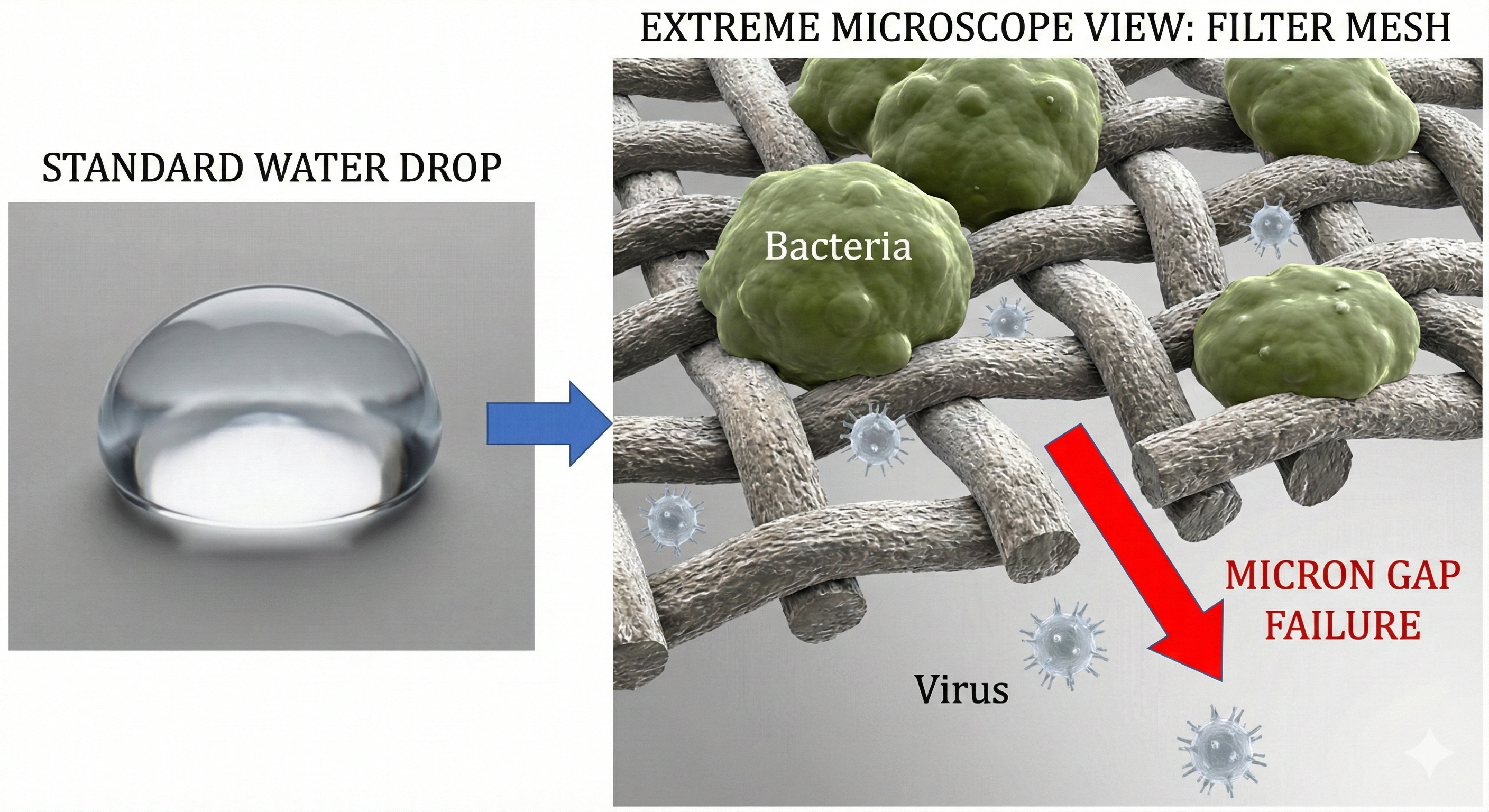
As an engineer, I view water treatment as a particle separation problem. The failure point lies in the micron rating. Standard hollow-fiber filters operate at 0.1 or 0.2 microns. This pore size is small enough to physically block Protozoa like Giardia and Cryptosporidium, and Bacteria like E. coli and Salmonella. These are the giants of the microbial world.
However, Viruses are the ghosts. Hepatitis A, Rotavirus, and Norovirus measure between 0.02 and 0.1 microns. They pass through a standard camping filter like a mosquito flying through a chain-link fence. To handle viral loads, you do not need a filter. You need a purifier.
I stress tested three common purification categories to determine which system actually belongs in your kit.
 The Physics Of Pure Water
The UV Solution: Katadyn SteriPen
It uses Ultraviolet light to scramble the DNA of microbes, rendering them unable to reproduce. It effectively neutralizes viruses, bacteria, and protozoa.
Turbidity. UV light requires line of sight. If your water is cloudy or silty, the suspended particles cast shadows that protect the pathogens. Furthermore, this is an electronic device. Batteries die. Circuits corrode. As I have stated before, a smartphone is a single point of failure. A UV wand is no different.
Acceptable for "Summit Sarah" staying in hotels who wants to treat tap water. Dangerous for field use where water clarity is not guaranteed.
The Mechanical Purifier: Grayl Geopress
This device uses electro-adsorption and ion exchange. You fill the outer cup and press the inner cup down, forcing water through a cartridge that captures pathogens like a magnet.
It physically removes viruses, chemicals, and heavy metals. It requires no batteries and no sucking. The user experience is frictionless.
Cost and lifespan. For "Gap-Year Gabe," the cartridges are expensive and degrade quickly with silty water. Once the flow rate stops, the cartridge is dead.The gold standard for international travel, provided you have the budget for replacement cartridges.
The Chemical Backup: Aquatabs / Chlorine Dioxide
The Physics: Chemical warfare. Chlorine dioxide damages the cell wall of the organism.
The Win: Weightless and cheap.
The Failure Point: Time. It takes 30 minutes to four hours to be effective, depending on water temperature. It offers no immediate gratification.
The Verdict: Mandatory redundancy. Every kit should contain a strip of tablets.
The Budget Protocol
If you cannot afford a mechanical purifier like the Grayl, you must build a hybrid system. Use a standard Sawyer filter to remove the sediment and bacteria (the big stuff), then treat the filtered water with drops of Chlorine Dioxide to kill the viruses. This two stage process is the most robust, cost effective method for the long term traveler.
Open your gear closet and check the micron rating on your filtration device. If it says 0.1 or 0.2 microns, understand that you are protected against biology, but vulnerable to virology. If your destination has a high viral risk, upgrade to a purifier or add a chemical stage to your workflow. Do not gamble your trip on a pore size that is too big for the threat.