The Sharpest Chisel: Why I Spent a Month Learning to Cut One Joint
The air in the workshop smelled of Hinoki cypress and discipline. It was a sharp, resinous scent that cleared the sinuses and the mind.
Outside, in the manicured center of Kyoto, thousands of visitors were currently shuffling through the Golden Pavilion, capturing the same photograph of a reflection in a pond. They were collecting proof of travel.
I was three miles north, in a shed with no air conditioning, no ticket booth, and no English signage, collecting blisters.
I had come to learn from Yamamoto-san, a Miyadaiku–a carpenter specializing in Japanese shrine architecture. These are the artisans who build temples that stand for a thousand years without a single metal nail.
I expected to learn how to build. Instead, for the first week, I learned how to disappear.
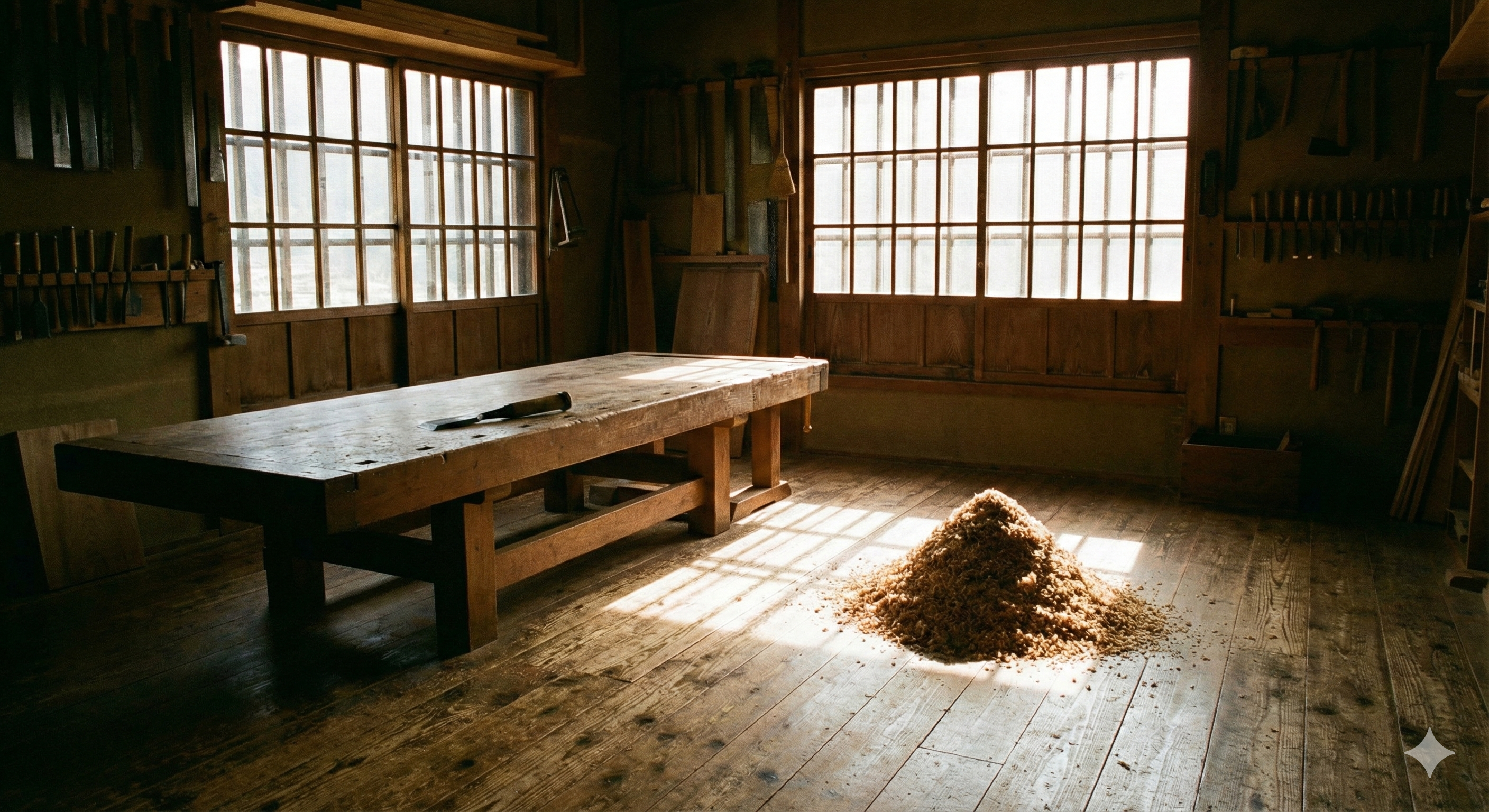 The Sharpest Chisel
The Art of the Broom
"Watch," Yamamoto-san said on day one. It was the only English word he used for the first forty hours.
He did not hand me a saw. He handed me a broom.
For the "Skill Seeker," this is the first test, and often the hardest. We are used to workshops that are transactional: I pay you fee, you teach me skill. But in a traditional shokunin (artisan) environment, the relationship is relational, not commercial.
I spent seven days sweeping sawdust. At first, my body vibrated with the phantom motion of a traveler addicted to "next". I wanted to touch the wood. I wanted to cut. But as I swept, I began to notice the floor. I learned where the wood chips fell most heavily (the planer). I learned the rhythm of the master’s work by the sound of his silence.
By day eight, I wasn't just cleaning a room; I was calibrating my internal clock to the pace of the workshop. I had stopped rushing. Only then did Yamamoto-san hand me a chisel.
The Violence of Nails
"Metal is impatient," he told me, through a translator I had brought for the afternoon. "A nail forces the wood to stay. It is violence. Joinery is an agreement. The wood stays because it fits."
The task was to create a Kanawa Tsugi–a complex splicing joint used to connect two pillars. It requires a precision of 0.1 millimeters. If the gap is too wide, the building shakes. If it is too tight, the wood splits.
I picked up the chisel. I struck the mallet. The wood splintered.
"Too loud," Yamamoto-san said, without looking up. "You are fighting the grain. Listen to it."
This was the "unspoken story" I had come to find. In the West, we often view materials as dead things to be manipulated. Here, the wood was treated as a living partner. The tree had spent a hundred years growing; to cut it poorly was an insult to that century of sunlight.
The Meditation of Sharpening
I spent the next two weeks not building, but failing.
I cut too deep. I cut too shallow. I rushed, and the joint wobbled. I got frustrated, and the wood reacted to my tension by cracking.
"Your mind is dull," Yamamoto-san said, taking my chisel. "So your tool is dull."
He took me to the whetstone. For three days, we did nothing but sharpen. Push, pull. Push, pull. The slurry of grey water and stone grit coated my fingers.
It was repetitive. It was boring. And it was profound.
I realized that I wasn't just sharpening steel; I was shaving away the layer of my own impatience. I stopped thinking about the finished product and started thinking about the edge. The goal wasn't to finish; the goal was to be sharp.
The Click
On day twenty-nine, it happened.
I didn't force the mallet. I didn't check my watch. I simply aligned the male and female ends of the cypress beams. I tapped them, gently.
Thunk.
It wasn't a loud noise. It was a solid, low-frequency sound of total closure. The two pieces of wood became one. No light passed through the seam. I tried to pull them apart; they wouldn't move. They were held together not by iron, but by friction and geometry.
Yamamoto-san walked over. He ran his thumb over the seam. He didn't smile–masters rarely do–but he nodded.
"Good," he said. "Now, do it again."
The Takeaway
I did not leave Kyoto with a finished table or a chair I could ship home. I left with a block of wood that fits into another block of wood.
But I also left with a "skill" that has nothing to do with carpentry. I learned that expertise is not a hack you can download or a workshop you can rush through in a weekend. It is a relationship with a material, forged in silence and repetition.
I went looking for a souvenir of my competence. I found the joy of being an apprentice.