Wi-Fi in the Wild: A Stress Test of Solar Generators and Satellite Internet
The Scottish Highlands do not care about your quarterly review.
The glen where I parked my van is a geological marvel of granite and moss. It is also a telecommunications dead zone. The cloud ceiling is at 400 feet, the ambient temperature is 45°F (7°C), and the rain is horizontal.
This is the "Nomad Dream" that Instagram filters out. In the marketing brochures, "Van Life" is always sunny, and the solar panels are always operating at peak efficiency. In reality, working remotely requires fighting thermodynamics and radio frequency physics.
I took a standard remote work setup–laptop, monitor, drone, and coffee grinder–into the wettest corner of the UK to answer two questions: Can you actually get online when the cell towers disappear? And can you keep the lights on when the sun vanishes?
I tested the Starlink Mini against a high-end 5G Signal Booster, and I pitted an Anker solar generator against a BLUETTI equivalent.
Here is the data from the edge of the grid.
Part 1: The Connectivity Battle
The Contenders:
The Incumbent: weBoost Drive Reach (5G Signal Booster).The Challenger: Starlink Mini (Low Earth Orbit Satellite).
The Physics: A signal booster is an amplifier. It takes an existing cell signal and shouts it louder to your device. However, amplifiers obey the rule of zero: Zero times one hundred is still zero. If a mountain blocks the cell tower, the booster has nothing to amplify.
Starlink ignores the mountain. It looks up.
The Test: I attempted to join a standard video call (requiring ~3 Mbps upload speed) from the base of a canyon in Glencoe.
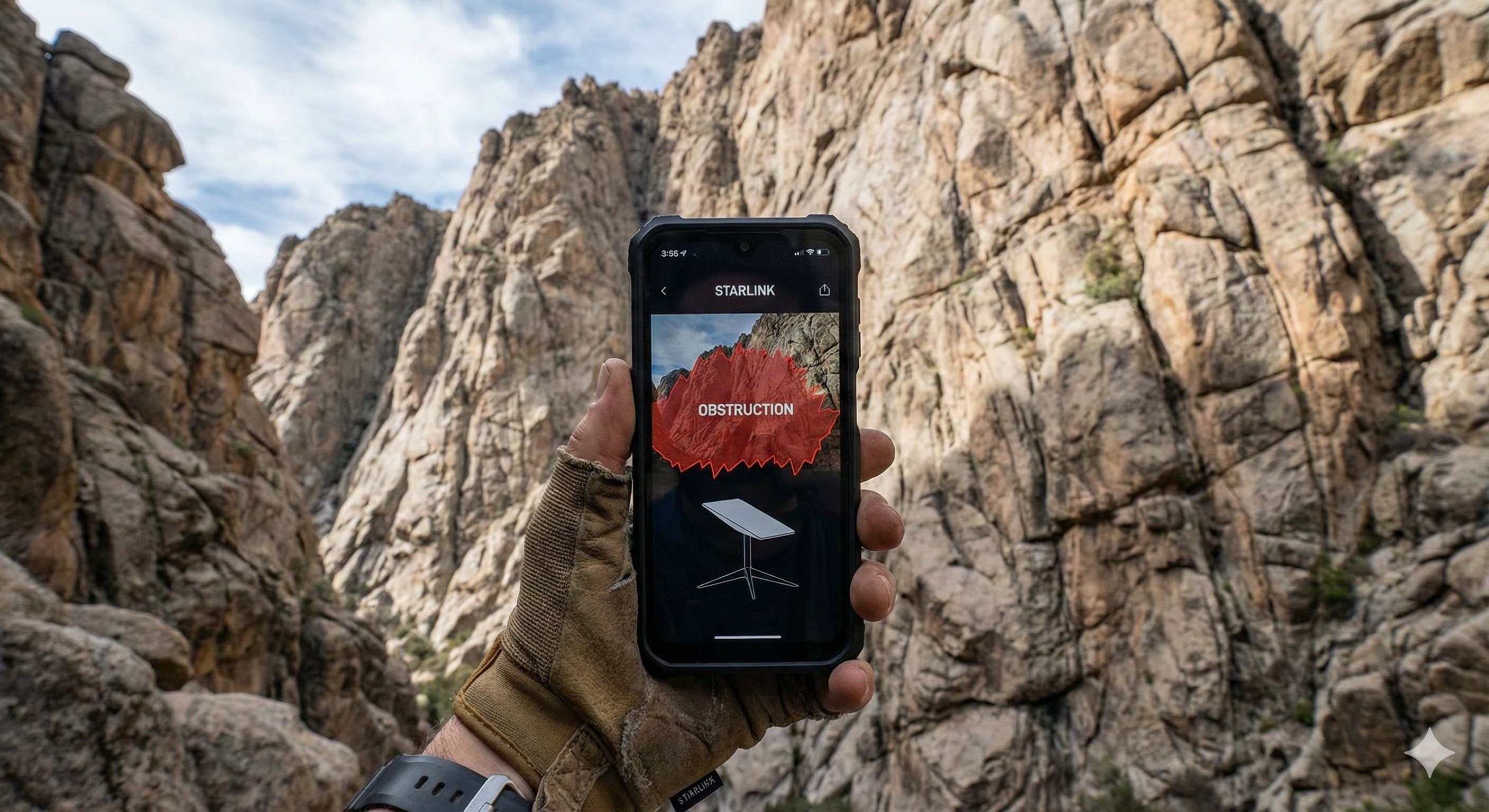
5G Booster: My phone showed one bar of 4G. The booster amplified this to three bars. Speed test: 12 Mbps down, 0.5 Mbps up.Result: I could hear the audio, but my video froze. The latency (lag) spiked to 400ms. Unusable for professional work.Starlink Mini: Setup took 4 minutes. The dish self-aligned. Because the canyon walls were steep, the app warned of "obstructions."Result: 85 Mbps down, 12 Mbps up. Latency: 45ms.The Catch: The Starlink Mini draws 25–40 watts of power continuously. The 5G booster draws 5 watts.
The Verdict: If you need to check email, a booster is fine. If you need to work, the booster is a gamble. Starlink is a utility. It changes the map from "coverage zones" to "sky visibility." For the true digital nomad, the satellite dish is no longer a luxury; it is infrastructure.
 Wi Fi In The Wild
Part 2: The Power Struggle
The Contenders:
Anker Solix C1000Bluetti AC180
The Marketing Lie: Every solar generator company sells you on "Peak Wattage." They claim a 200W solar panel will generate 200 watts. This is a laboratory number. It assumes a perfect angle, zero heat resistance, and an equatorial sun.
In Scotland, under a grey blanket of stratocumulus clouds, I measured the Actual Input Wattage.
The Test: I connected a generic 200W foldable panel to both units.
The Claim: 200 Watts input.The Reality (Anker): 38 Watts.The Reality (Bluetti): 42 Watts.
The Engineering Analysis: Both units use MPPT (Maximum Power Point Tracking) controllers, which regulate the erratic energy from the sun. The Bluetti’s controller was slightly more sensitive in low-light conditions, squeezing an extra 4 watts out of the grey sky.
However, the math is brutal. At 40 watts of input, it will take 25 hours of daylight to recharge a 1000Wh battery. In Scotland, that is four days.
Meanwhile, the Starlink is burning 40 watts per hour.
Input: 40W (Solar)Output: 40W (Starlink) + 60W (Laptop) = 100W total load.Net Loss: -60W per hour.
The Verdict: Solar is not a power source; it is a trickle charger. You cannot run a remote office off solar panels alone unless you are in Arizona.
For climates like this, you need Battery Capacity, not just solar speed. The Anker C1000 charges from a wall outlet (AC) in under an hour (58 minutes in my test). The Bluetti took 90 minutes.
If you are a Nomad Noah living in a van, the winning strategy is Alternator Charging (charging while driving) or AC fast-charging at a coffee shop. Do not rely on the sun to keep your job.
The Integrated System Checklist
If you are taking your career into the wild, stop optimizing for "sunny days." Build a system for the storm.
Oversize the Battery: Calculate your daily usage, then double it. You need a buffer for two days of rain. I recommend a minimum of 1000Wh for laptop users.The Satellite Tax: If you use Starlink, you must budget an extra 400Wh of battery per day just to keep the internet on.The Backup Brain: I carry a secondary 5G hotspot from a different carrier than my phone. Redundancy is the only thing that saves you when the hardware fails.
The Bottom Line: Technology allows us to leave the city, but physics follows us. The Starlink Mini works miracles, but it demands power. The solar panels promise freedom, but they demand sun.
You can work from the wilderness, but you cannot be passive about it. You are no longer just an employee; you are the manager of your own utility grid. Plan accordingly.